
Overview of Vitiligo
Vitiligo is an autoimmune skin disorder marked by well-demarcated depigmented macules or patches resulting from melanocyte destruction. Affecting 2% of global population, vitiligo poses a significant psychosocial burden, with approximately 75% of patients experiencing psychological distress, decreased self-confidence, and social withdrawal. Vitiligo often manifests before the age of thirty and has no gender predilection.
The exact pathogenesis of vitiligo remains inconclusive, however, it was hypothesized that interactions between autoimmunity, genetic susceptibility, and oxidative stress lead to impaired melanocyte proliferation, adhesion, migration, and premature cell senescence. An integrated mechanism involving these processes likely governed by CD8+ T cells that specifically targeting the melanocytes.
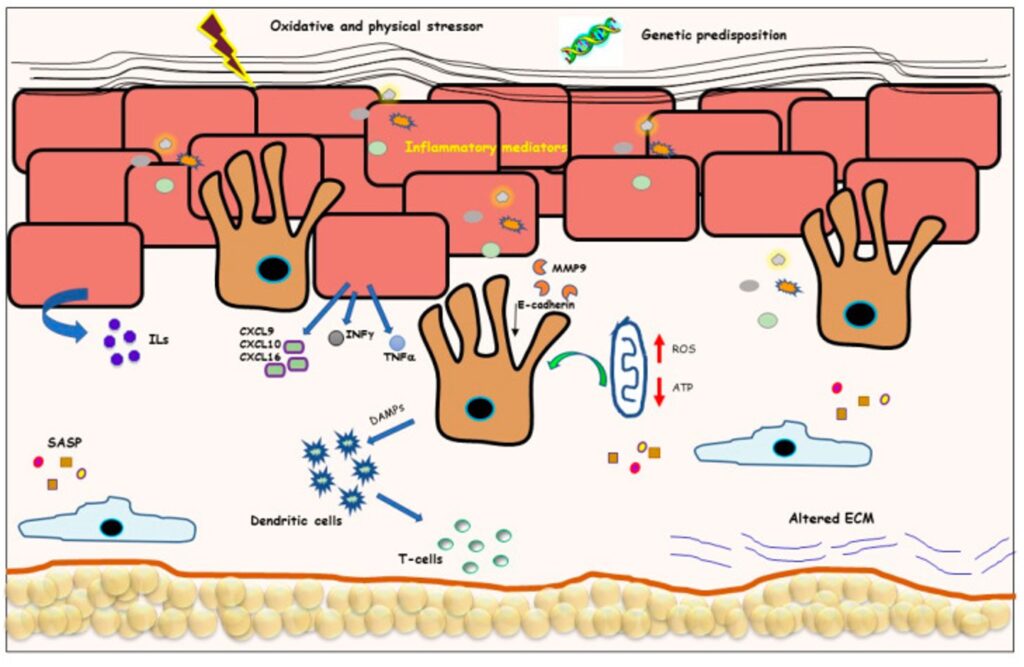
Figure 1. Pathogenesis of vitiligo. Stressor from physical and oxidative, as well as genetic predisposition leads to the production of several inflammatory mediators. This will further increase the level of reactive oxygen species (ROS) and decrease ATP content involving dermal and epidermal cells.
Despite numerous therapeutic options such as topical corticosteroids, calcineurin inhibitors, phototherapy, and surgical grafting, no current therapy ensures consistent, complete, and durable repigmentation of the skin into its native conditions. Thus, there is a pressing need for novel, effective, and safe treatments that might fill the gap of current treatments.
Secretome as a Promising Therapy
Secretome refers to soluble factors secreted by mesenchymal stem cells (MSCs), containing factors such as cytokines, chemokines, growth factors, angiogenic factors, and extracellular vesicles such as exosomes and microvesicles. Secretome has been used in numerous dermatological cases, including acne, atopic dermatitis, psoriasis, lichen sclerosus, wound healing, and hair loss due to its multifaceted mechanism if actions. MSCs can be derived from bone marrow, adipose tissue, umbilical cord, placenta, amniotic fluid, and other sources.
Secretome, in some cases, are preferred compared to MSCs due to high effect durability, low immunogenicity, and minimal influence from environmental or genetic factors. Moreover, it also poses lower risk of tumor formation and is easier to be produced, stored, and transported. With various factors contained, secretome offers multiple pathway in treating vitiligo, including:
- Modulation of immune system. Secretome might inhibit the proliferation of CD8+ T cells and increases regulatory T cells, thus, restore immune tolerance against melanocytes. Secretome contains IL-2, IL-7, IL-12, and IL-15 that cell proliferation and tissue repair. Furthermore, it also contains IL-1α, IL-1β, IL-6, IL-8, and GM-CSF that shows anti-tumorigenic effects.
- Regeneration and support of melanocytes. Secretome is rich in growth factors, such as bFGF, MGF, HGF, FGF-2, PDGF-AA, that might promotes melanocyte proliferation, migration, and survival. Therefore, the melanocytes might start repigmentation in the site of vitiligo. Moreover, secretome are proven in some studies to rescue apoptotic cells, thus, prevent the melanocytes from dying.
- Anti-inflammatory and anti-oxidant. Secretome might reduce the expression of proinflammatory cytokines, contributing to its protective role in skin inflammation. Furthermore, secretome might counteracts reactive oxygen species, a key contributor to melanocyte destruction. Secretome might upregulate antioxidant genes, restores mitochondrial function, and reduces ROS in skin cells.
Evidence from Clinical Studies
In clinical practice, promising results have been reported with the combination of microneedling and topical secretome derived from Wharton’s jelly mesenchymal stem cells (WJMSC). Microneedling creates microchannels in the skin that facilitate secretome penetration, stimulating regenerative process that support pigment restoration. A case report involving a vitiligo patient demonstrated visible repigmentation after secretome application, with no reported side effects.
Looking forward, secretome might be a promising option for vitiligo treatment. Combining secretome with existing treatment such as phototherapy or melanocyte transplantation could potentially improve treatment outcomes by targeting immune dysregulation and melanocyte regeneration. Furthermore, secretome might serve as an adjuvant therapy in surgical interventions such as punch graft to improve graft retention and survival of transplanted melanocytes. However, before secretome therapy can be adopted confidently in everyday clinical practice, strong evidence from large-scale randomized controlled trials is necessary to validate its safety and efficacy. With further research, secretome has the potential to provide more consistent and long-lasting repigmentation for vitiligo patients, offering hope for better management of this challenging condition.
References
- Bellei B, Papaccio F, Picardo M. Regenerative medicine-based treatment for vitiligo: An overview, Biomedicines. 2022 Nov 1;10(11).
- Bibeau K, Pandya AG, Ezzedine K, Jones H, Gao J, Lindley A, et al. Vitiligo prevalence and quality of life among adults in Europe, Japan, and the USA. J Eu Acad Dermatol Venereol. 2022 Oct 1;36(10):1831.
- Chandra CC, Tan ST, Tanely W, Christian C, Heny D. A new pigment from mesenchymal stem cell’s secretome for segmental vitiligo: A case report. International Journal of Dermatology, Venereology and Leprosy Sciences. 2024; 7(2): 147-149.
- Damayanti RH, Rusdiana T, Wathoni N. Mesenchymal stem cell secretome for dermatology application: A review. Clin Cosmet Investig Dermatol. 2021 Oct 5;14:1401-12. 6. Bellei B, Papaccio F, Picardo M. Regenerative medicine-based treatment for vitiligo: An overview. Biomedicines. 2022 Nov 1;10(11). 7.
- Eleftheriadou V, Atkar R, Batchelor J, McDonald B, Novakovic L, Patel JV, et al. British Association of Dermatologists guidelines for the management of people with vitiligo 2021. Br J Dermatol. 2022 Jan 1;186(1):18-29.
- Kubelis-López DE, Zapata-Salazar NA, Said-Fernández SL, Sánchez-Domínguez CN, Salinas-Santander MA, Martínez-Rodríguez HG, et al. Updates and new medical treatments for vitiligo (Review). Exp Ther Med. 2021 May 25;22(2):797.
- Martins C, Migayron L, Drullion C, Jacquemin C, Lucchese F, Rambert J, et al. Vitiligo skin T cells are prone to produce type 1 and type 2 cytokines to induce melanocyte dysfunction and epidermal inflammatory response through Jak signaling. J Invest Dermatol. 2022 Apr 1;142(4):1194-1205.e7
- Peshkova M, Korneev A, Damayanti RH, Rusdiana T, Wathoni N. Mesenchymal stem cell secretome for dermatology application: A review. Clin Cosmet Investig Dermatol. 2021 Oct 5;14:1401-12.6.